








 12 Years a Slave
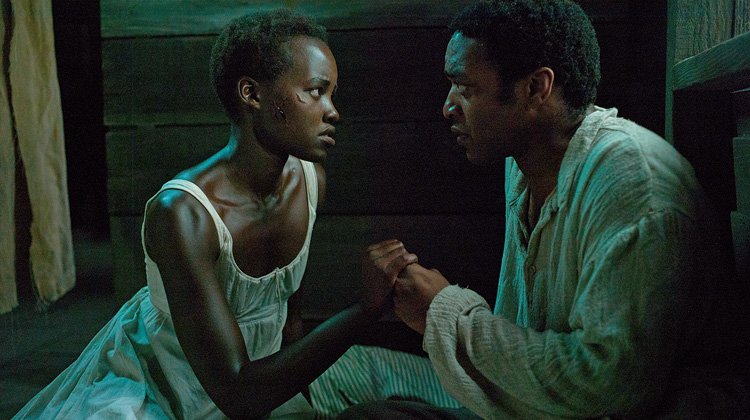
2013 | Steve McQueen
By Mark Tapio Kines
With 12 Years a Slave already touted as 2013’s Best Picture Oscar frontrunner just days after its premieres at Telluride and Toronto, such dazzling hype may be unfair to something better discovered quietly. For it is a very good film, excellently performed and more or less faithful to the memoirs of Solomon Northup, a free black man in New York who in 1841 was shanghaied in Washington, D.C. and sold into slavery in Louisiana. Indeed, it is a very good film, but in my opinion not a great one.
First, the good news: As Northup, British actor Chiwetel Ejiofor is flawless. He is sympathetic without being mawkish, brave without being unbelievably heroic. He is nothing less than human, a decent man trying to survive under awful circumstances. The cast that surrounds him is fine, and director McQueen frames his shots very elegantly, depicting the surrounding Louisiana landscape as both beautiful and sinister. Hans Zimmer’s score seems almost suited to a horror film, but it befits the horrific proceedings.
However, there is one big problem I had with 12 Years a Slave, and I can sum it up in one word: Roots.
I saw the cherished 1977 miniseries a couple of years ago, and although it hasn’t aged well, with its cheap network TV aesthetics and its bevy of familiar television actors in fleeting guest roles, in its strongest moments Roots is still very effective at holding the ugly truth of slavery up to the light and forcing us to look.
36 years later, 12 Years a Slave essentially covers the same ground, adding little new to our understanding of this terrible chapter of American history. Because it’s an R-rated film, it’s certainly more graphic than Roots, and McQueen’s artful visuals elevate the material. But it otherwise offers the same tropes as the ’77 miniseries: ghastly whipping scenes, Southern whites behaving in appalling ways, slaves being scared out of their wits. It doesn’t help that 12 Years a Slave, like Roots, pulls the same distracting stunt casting. Instead of Robert Reed and Lorne Greene, we now get Benedict Cumberbatch and Paul Giamatti.
I had hoped that 12 Years a Slave could have taken a fresh approach, at least exploring Northup’s attitude toward his fellow slaves: did he see them as his inferiors? How did they see him, in turn? It could have made for an interesting character arc. But he is rarely shown interacting with them, aside from two particularly downtrodden women. Presumably, Northup did not discuss these surely complex interrelationships in his memoir, and the script by John Ridley doesn’t attempt to invent any.
This is still a strong film, coolly objective in its own way, even while it depicts acts of unspeakable cruelty. But despite its protagonist’s unique viewpoint, it still keeps slavery at a safe distance from contemporary audiences. In short, we never identify with any of the characters in this bygone world, aside from Northup himself. By the end of the film, one feels like saying, regarding slavery, “Well, thank God that’s all behind us,” which may not exactly be the right sentiment.
Mark Tapio Kines is a film director, writer, producer and owner of Cassava Films. You can reach Mark here.













Leave a Reply